A kitchen knife is the most personal tool you'll ever buy for your home. It touches nearly every meal, it lasts decades if chosen well, and it's also the purchase where marketing does the most damage — steering people toward gleaming blocks of knives they don't need and away from the single blade that would actually change their cooking. Here's an honest guide to picking a knife worth keeping: what matters, what's noise, and how to care for the thing so it outlives the trends.
One Knife Does Most of the Work
Before comparing steel and handles, get the big decision right: buy one excellent chef's knife rather than a set of adequate ones. In a working kitchen, a chef's knife in the eight-inch range handles the overwhelming majority of tasks — chopping, slicing, dicing, mincing, breaking down proteins. The classic knife block spreads your budget across eight or twelve blades, most of which exist to fill slots. A carving knife you use twice a year, a boning knife you never use, steak knives of gift-shop quality — and a chef's knife that got whatever budget was left over.
The better plan is three knives bought individually: the chef's knife where most of the money goes, an inexpensive paring knife for close handwork, and a serrated bread knife, where even cheap versions perform well. Everything else is optional and can wait until your cooking demands it. When a genuine need does appear — a santoku because the shape suits your chopping style, a slicing knife because you roast often, a smaller utility blade for sandwich duty — you'll buy it knowing exactly why, which is the opposite of how blocks are bought. Knives acquired one at a time, each answering a real habit, produce a drawer where everything gets used. Blocks produce dust.
Steel, Simplified
Knife marketing loves steel jargon, but the practical landscape is simple. Harder steels — common in Japanese-style knives — take a keener edge and hold it longer, but they're more brittle, meaning they can chip if you twist them through squash or hit a bone. Softer steels — the German-style tradition — dull a little faster but shrug off abuse and sharpen easily. Neither is better; they reward different owners. If you sharpen regularly and cut with care, harder steel rewards you with effortless precision. If your knife leads a rougher life, softer steel forgives you.
Stainless versus carbon steel is the other fork in the road. Carbon steel takes a wonderful edge and develops a gray patina with use, but it will rust if left wet — it suits people who enjoy maintaining their tools. Stainless asks almost nothing of you. For most homes, a good stainless blade is the right honest answer, and anyone who tells you otherwise is describing their hobby, not your kitchen.
Blade shape deserves a quick word too. The German profile curves more, suiting cooks who rock the blade through herbs and vegetables; the flatter Japanese-style profile suits up-and-down chopping and precise slices. Hybrid shapes split the difference and are a safe default. Again, there's no winner — there's the motion your hands already make, and a blade that matches it.
The Handle Matters More Than the Brand
Here is the part no spec sheet captures: a knife has to fit your hand. Handle shapes, blade weights, and balance points vary enormously, and the knife a reviewer loves may feel like a brick to you. Heavier knives power through dense vegetables and feel substantial; lighter knives are nimbler and kinder over a long prep session. Neither is correct — but one of them is correct for you.
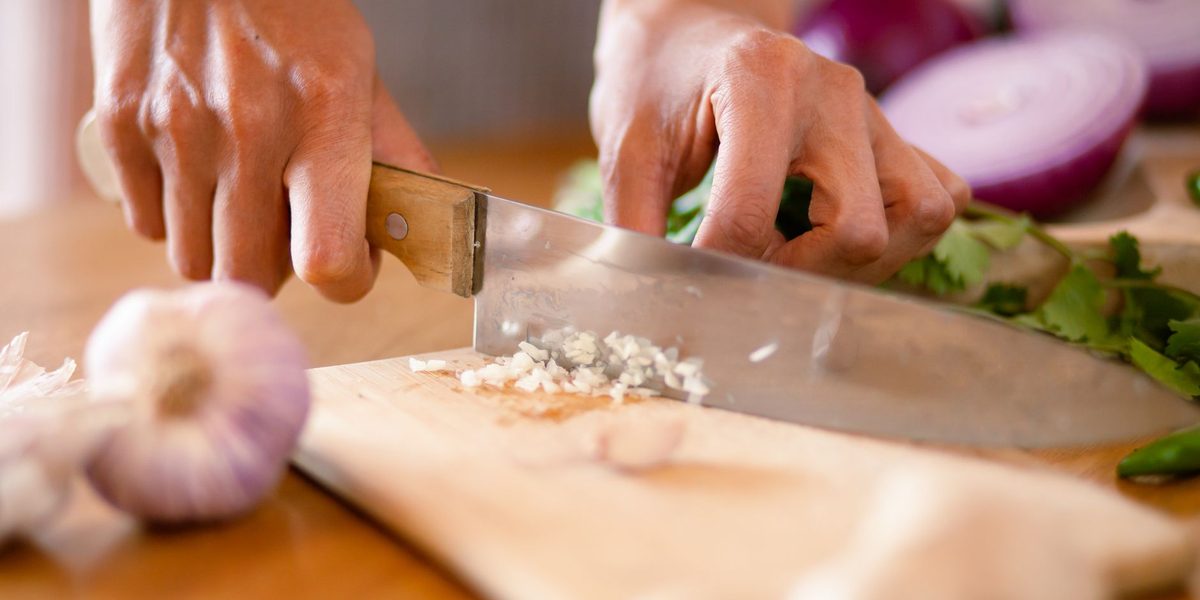
If at all possible, hold a knife before buying it. Grip it the way cooks actually do, with thumb and forefinger pinching the blade just ahead of the handle, and check three things: nothing digs into your palm, the knife doesn't feel like it's tipping forward or backward out of your grip, and your knuckles clear the cutting board when the edge is down. Thirty seconds of holding tells you more than thirty reviews. If you must buy without touching, buy from somewhere with easy returns and treat the first week as an audition.
Ignore These Selling Points
A few features exist mainly to justify price tags, and knowing them saves real money:
- Full blocks and huge sets — you're paying for quantity, not quality, and for knives designed to fill a slot rather than a need.
- Never needs sharpening claims — every knife dulls; blades marketed this way are usually serrated in ways that can't be resharpened, making them disposable by design.
- Forged versus stamped snobbery — forged blades were once clearly superior, but modern stamped knives can be excellent; judge the knife, not the manufacturing story.
- Exotic pattern-welded finishes — the rippling layered look is beautiful and adds nothing to performance at typical price points; it's fashion, priced like function.
- Bundled sharpeners built into blocks — pull-through slots grind edges unevenly and remove far more metal than needed.
None of these makes a knife bad. They're just the wrong reasons to choose one, and they're precisely the features designed to close a sale.
Sharpness Is a Habit, Not a Purchase
A mediocre sharp knife outperforms a premium dull one every single day, which means maintenance decides more than the purchase does. Two tools cover it. A honing rod — used for a few strokes weekly — doesn't sharpen but realigns the microscopic edge, keeping a sharp knife acting sharp. Actual sharpening, which removes metal to create a fresh edge, is only needed a few times a year in a home kitchen. A whetstone gives the best result and is a genuinely learnable skill; a quality guided sharpener is a fine middle path; and a professional sharpening service once or twice a year is a perfectly respectable choice that costs less than lunch.
Just as important is what the knife touches. Wood or plastic boards only — glass and stone destroy edges. Never toss a good knife loose into a drawer where it knocks against other metal; use a magnetic strip, an in-drawer tray, or a blade guard. And wash it by hand. Dishwashers batter edges against racks, bake handles dry, and are the leading cause of death for good knives.
How Much to Spend
The satisfying truth: the price-to-performance curve flattens fast. The jump from a flimsy bargain-bin knife to a solid mid-priced one is enormous — better steel, better geometry, a blade that holds an edge. The jump from mid-priced to luxury is mostly refinement, finish, and pride of ownership. Real pleasures, but not sharper onions. A sensible target for most people is a mid-range chef's knife from any reputable maker, held in the hand first, plus a modest sum for the paring and bread knives. Spend the money you saved on a whetstone or a yearly professional sharpening, and your modest knife will outperform a neglected expensive one for the rest of its very long life.
Final Thoughts
Choosing a knife worth keeping comes down to resisting the block, finding the blade that fits your hand, and committing to the small habits that keep it sharp. Steel type and country of style matter far less than fit and upkeep. Buy one good chef's knife, treat it like the decades-long companion it is, and you'll understand why cooks get quietly sentimental about a piece of sharpened metal. The right knife stops being a purchase and becomes a habit — which is the highest compliment a tool can earn.