A power bank is the least glamorous gadget you can buy and one of the most quietly valuable: a dead phone is a lost boarding pass, a missed ride, a map that no longer exists. Yet the category is a swamp of inflated numbers, mystery brands, and specs that mean nothing to normal humans. The result is predictable: people buy either a keychain trinket that cannot revive a phone or a brick that never leaves the drawer because it weighs as much as a paperback. Matching a power bank to your actual habits takes about five pieces of plain-language knowledge, and this guide covers all of them.
Capacity, Translated Into Real Life
Power bank capacity is measured in milliamp-hours, a number that means little on its own, so translate it into the only unit that matters: full phone charges. Because of conversion losses, a power bank delivers roughly two-thirds of its printed capacity to your device, an honest fact of physics that respectable makers acknowledge and shady ones hope you never learn. As a rule of thumb, a small bank around the five-thousand mark yields about one full phone charge, the popular ten-thousand class yields around two, and the twenty-thousand heavyweights manage four or more, with tablets consuming double or triple a phone's share.
Choose by scenario, not by maximum. A daily-carry bank that tops you up on a long day needs one charge of headroom. A weekend trip wants two. A festival, camping trip, or long-haul travel day with two devices justifies the big class. Bigger is not better if it stays home; the best capacity is the largest one you will actually carry.
The Size and Weight Trade-Off Nobody Escapes
Battery chemistry is dense, and capacity scales with physical mass almost linearly, which means every step up in charges is a step up in pocket weight. The small class disappears into a jacket pocket; the midsize class rides comfortably in a bag but stretches trousers; the large class is luggage. This is why owning one perfect power bank is a myth for anyone with a varied life, and why the most satisfied owners often keep two: a slim everyday bank and a big travel one.
Be especially wary of banks that promise huge capacity in impossibly small bodies at suspicious prices; battery physics does not do miracles, and inflated labels are the signature move of no-name sellers. A reputable maker's honest number beats a fantasy number that overheats in your bag, and the weight test is a decent lie detector: a battery that feels suspiciously light for its claimed capacity almost certainly does not have it.
Charging Speed Matters in Both Directions
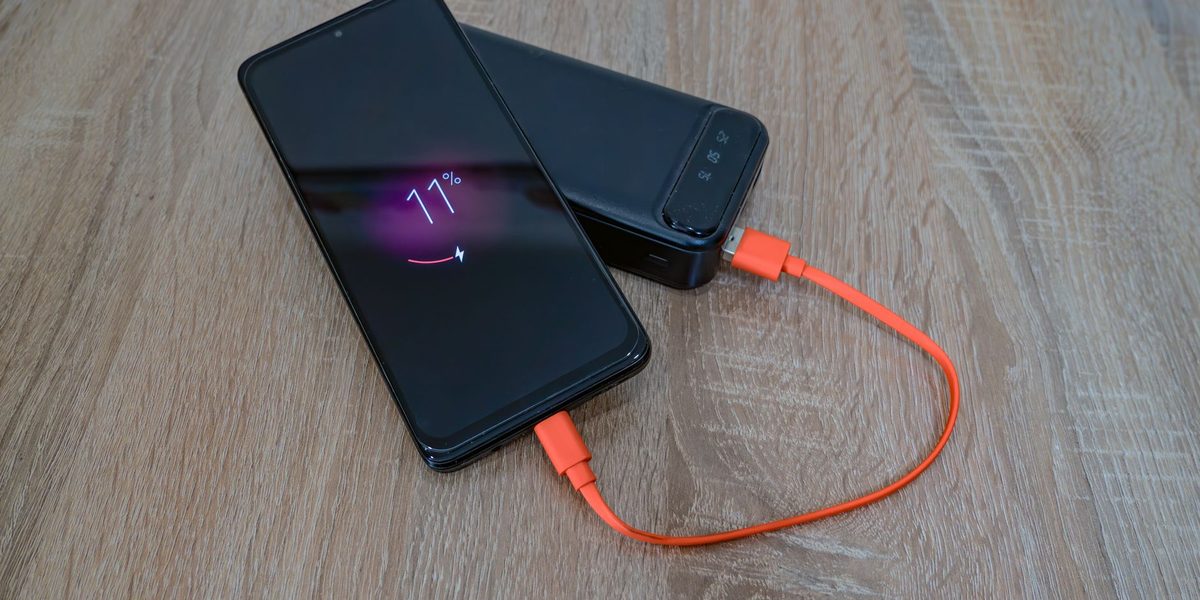
Speed questions come in two flavors, and both shape daily happiness. Output speed determines how fast the bank refills your phone: modern fast-charging standards can push a phone from empty to most of a charge in well under an hour, while an old slow-output bank trickles for three. If your phone supports fast charging, and nearly all now do, a bank that speaks the same fast-charging language is worth insisting on, and it needs a proper cable to deliver it.
Input speed, the neglected sibling, determines how fast the bank itself refills. Big banks with slow input take all night and then some, which in practice means they are never full when you need them. Look for banks that recharge quickly, and note the genuinely useful pass-through feature on some models, which lets the bank charge itself and your phone simultaneously from one outlet, turning it into a tiny charging station on nightstands and in airports.
Ports, Cables, and the Small Features That Decide Everything
A short checklist separates banks that serve for years from ones that annoy for months:
- Modern ports: favor banks built around the current universal connector standard for both input and output, so one cable type serves your phone, the bank, and most of your other gear.
- Two or more outputs: charging your phone and your earbuds, or your phone and a friend's, is a constant real-world scenario.
- Built-in cable models: a bank with its own attached cable can never be forgotten separately, a feature whose value scales with your forgetfulness.
- A clear charge indicator: proper percentage displays beat cryptic blinking dots; knowing whether the bank holds one charge or none is the whole point.
- Small-device mode: earbuds and watches sip power so gently that some banks shut off mid-charge; a low-current mode fixes this.
- Wireless top-up pads: convenient for cable-free desks, but slower and lossier, so treat as a bonus rather than a main course.
None of these appear in the headline spec, and together they matter more than another thousand milliamp-hours ever will.
Flying With Power Banks: The Rules in Plain Language
Every frequent traveler learns this at a security line eventually, so learn it here instead: power banks are lithium batteries, and airlines universally require them in carry-on bags, never in checked luggage. Capacity limits apply as well; the common consumer sizes up through the twenty-thousand class are generally fine to carry, while the very largest bricks can require airline approval or be refused outright, and rules vary by carrier and country. Check your airline's current policy before flying with anything unusually large, keep the bank where inspection is easy, and make sure its capacity label is legible, because unlabeled batteries are the ones that get confiscated.
The travel angle also argues for quality: a bank that will live in bags, seat pockets, and temperature swings should come from a maker with real safety certifications and overcharge protection, not from the bargain bin of an anonymous marketplace listing.
Matching the Bank to Your Actual Life
Pull it together with a quick self-portrait. The light commuter, whose phone occasionally dips scary-low on long days, wants the slimmest one-charge bank with fast output, small enough to forget. The daily heavy user, living on maps and video, wants the two-charge midsize class with fast input and output and two ports. The traveler and festival-goer wants the big class with a percentage display, pass-through charging, and airline-friendly labeling. Parents want capacity plus an extra port, because a child's dead tablet is a family emergency. And almost everyone does better owning the right two banks than the wrong one, since the drawer-bound brick and the useless trinket cost more together than a sensible pair.
Whatever profile fits, buy from established makers, expect honest two-thirds delivery from any printed capacity, and replace banks that swell, heat up oddly, or lose most of their capacity with age, because batteries are consumables, not heirlooms. Two final habits stretch any bank's useful life: store it around half charge rather than full or empty if it will sit unused for months, and top it up on a calendar reminder every couple of months, because the bank that has quietly self-discharged to zero in a drawer is the one that fails you on the day it was bought for.
Final Thoughts
A good power bank is bought once, thought about never, and thanked silently in airports, campsites, and long afternoons for years. Get there by translating capacity into real charges at two-thirds honesty, matching size to what you will genuinely carry, demanding fast charging in both directions, and checking the small features, ports, indicators, and attached cables, that decide daily convenience. Keep it in your carry-on when you fly, and spend the few extra dollars that separate certified quality from marketplace roulette. The dead-phone emergency you never have again will pay for it many times over.